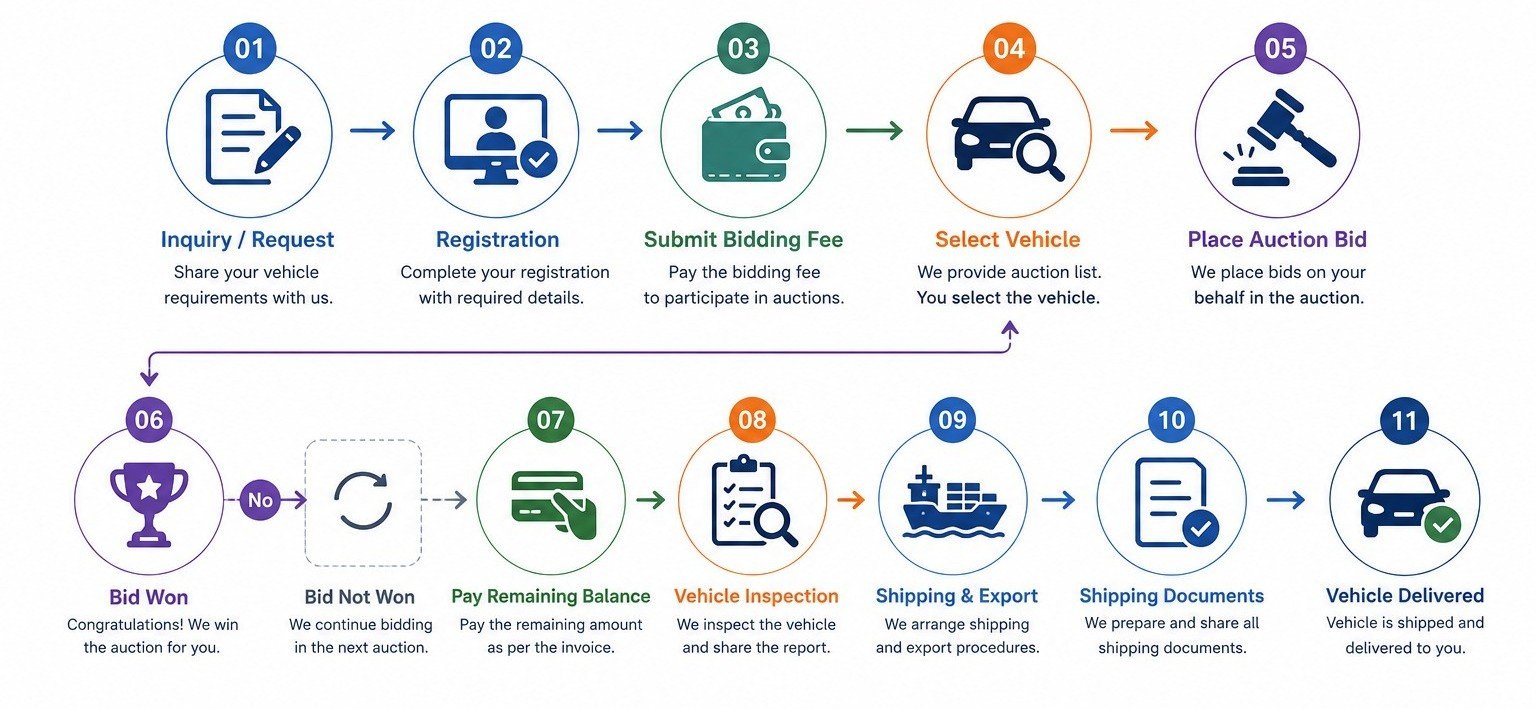
Bid directly on vehicles from Japan's largest auction houses with the support of Japan Wheels professional auction team.
Submit your desired vehicle details and our team will monitor upcoming auctions.
Access thousands of vehicles from Japan's leading auction houses every week.
Our experts translate and explain every auction sheet before bidding.
Get professional advice before placing your bid.
If you’re holding a Japanese auction sheet full of kanji, symbols, and handwritten notes, here’s the short answer: auction sheet translation means converting the grade, damage diagram, and inspector’s remarks from Japanese into English so you can understand a car’s real condition before you buy.
This guide translates every part of the sheet. The grades, the damage codes, the abbreviations, and even the handwritten phrases inspectors actually write are all based on one consistent, verified standard.
The overall grade sits in the top corner of the sheet and is the single most-quoted number when buyers or dealers discuss a car.
Grading standards vary slightly between auction houses (USS, TAA, JU, ARAI, JAA, HAA, and CAA), but the table below reflects the convention used by the large majority of Japanese auctions.
| Grade | Meaning |
|---|---|
| S | Virtually new: registered within the last year, minimal use |
| 6 | Near-new condition, very low mileage, no repair history |
| 5 | Excellent, only minor, hard-to-notice scratches or dents |
| 4.5 | Clean, with light cosmetic wear; no engine or body repair |
| 4 | Good, above-average condition; small scratches or dents possible |
| 3.5 | Noticeable wear: scratches, dents, some interior marks |
| 3 | Rough condition, heavier marks, visible interior wear |
| 2 | Poor — significant damage, corrosion, or non-accident modification |
| R | Accident-repaired in Japan; one or more panels replaced or repaired |
| RA | Accident-repaired, with damage assessed separately from the numbered grades |
In practice, this varies by auction house and even by individual inspector, so don’t rely on the letter alone.
Always check the damage diagram and the inspector’s notes for the specific panels and severity involved; that’s the real signal, not the grade letter alone.
A grade above 4 with an interior grade below B is still worth a second look. The numbers don’t always move together, which is exactly why interior and exterior are graded separately.
| Grade | Interior Condition |
|---|---|
| A | As-new; no visible wear |
| B | Clean, minor everyday use only |
| C | Average: light stains, minor marks |
| D | Poor: odors, tears, burns, heavy wear |
| E | Severe deterioration |
Exterior condition is generally read from the damage diagram itself rather than a separate letter scale, since the diagram already shows panel-by-panel condition.
Not automatically unsafe, but it should trigger closer inspection, not automatic rejection.
The diagram in the corner of the sheet marks the exact panel where each issue was found, using a short code.
| Code | Category | Meaning |
|---|---|---|
| A1 – A3 | Scratch | Small to large/deep scratch |
| U1 – U3 | Dent | Minor to large dent |
| B1 – B4 | Dent + scratch | Combined damage, minor to major |
| W1 – W3 | Repaint | Panel repainted or repaired, minor to poor finish quality |
| X | Replacement needed | Panel requires replacement |
| XX | Already replaced | Panel has been replaced, a bigger flag than a simple scratch |
| C1 – C4 | Rust / corrosion | Light surface rust to serious corrosion |
| P1 – P3 | Paint condition | Fading, peeling, or discoloration |
| Y1 – Y4 | Crack | Small crack to major crack or hole |
| G | Glass | Stone chip or crack on windscreen/glass |
A cluster of codes on one panel, or a repeated XX, is worth more attention than a single isolated A1 scratch. Read the diagram for patterns, not just individual marks.
Auction sheets also list standard equipment using short codes:
| Code | Meaning |
|---|---|
| AB | Airbag |
| AW | Alloy wheels |
| PS | Power steering |
| PW | Power windows |
| SF | Sunroof |
| TV | Television/entertainment system |
Beyond the grade and the diagram, inspectors write dozens of short, standardized Japanese phrases and abbreviations across the sheet, and once you recognize the patterns, they’re not hard to read.
| Term | Meaning |
|---|---|
| F | Front |
| R | Rear (also occasionally right) |
| D | Driver’s side (seat, door, mirror, handle) |
| E/G | Engine |
| HID | Xenon headlights |
| CS | Cassette recorder |
| T-BELT | Timing belt |
| ST-T | Studless (winter) tires |
| CP | Center cap |
| 右 | Right |
| 左 | Left |
| 下 | Bottom |
| 大 | Large / strong (severity) |
| 小 | Small / slight (severity) |
| 多 | Numerous, a lot of |
| 穴 | Hole / missing |
| 欠 | Absent, missing |
| Japanese | English |
|---|---|
| ミラ | Mirror(s) |
| ドア | Door(s) |
| ばんぱ | Bumper |
| スポ | Spoiler |
| エアロ | Body kit |
| モール | Molding |
| ホイル | Alloy wheels |
| 下廻り | Underbody |
| 足廻り | Suspension system |
| バッテリ | Battery |
| コアサポート | Radiator core support |
| クロスメンバ | Cross member |
| サイドメンバー | Side member |
| フェンダ | Fender |
| インサイドパネル | Inner panel |
| エンドパネル / バックパネル | Rear panel |
| トランクフロア | Trunk floor |
| ピラ | Pillar (front, center, rear) |
| シート | Seats |
| ダッシュ板 / ダッシュボード | Dashboard |
| ハンドル | Steering wheel |
| フロアマット | Floor mat(s) |
| ナビ | Navigation system |
These are the root Japanese words the A/U/W/C symbol system is built from. Recognizing them lets you read a handwritten note even without the diagram in front of you.
| Japanese | English | Related Code |
|---|---|---|
| キズ / 傷 | Scratch(es) | A |
| へこみ / 凹 | Dent(s) | U, B |
| 補修あと | Repair mark(s) | W |
| フショク | Corrosion | C |
| ヒビ / ワレ | Crack | Y |
| トビ石 | Stone chip | G |
| 修理 / シュウリ | Repaired | — |
| 修理要 | Needs to be repaired | — |
| 不良 | Defective | — |
| 汚れ | Contaminated / dirty | — |
| コゲ | Cigarette burn mark | — |
| 歪み / ヒズミ | Deformation | — |
| Japanese | English |
|---|---|
| 内装うす汚れ | Slight interior contamination |
| 内装汚れ(大) | Strong interior contamination |
| 天張り汚れ | Dirty roof lining |
| 室内キズ汚れ | Scratches and interior contamination |
| シートコゲ穴 | Cigarette burn holes on seats |
| シートシワ | Wrinkles on seats |
| シートヘタリ | Seat cushion is worn/flattened |
| 室内異音 | Noise inside the cabin |
| 室内臭い | Unpleasant smell inside the cabin |
| AC不良 | Defective air conditioner |
| モニタ不良修理要 | Defective monitor, needs repair |
| P/W不良修理要ス | Defective power windows need repair |
This vocabulary is what actually explains an R or RA grade on a sheet.
| Japanese | English |
|---|---|
| F事故 | Front-end accident damage |
| 右面事故 | Right-side accident damage |
| F-R事故 | Front and rear accident damage |
| 側面修理歴 | Both sides of the chassis have repair history |
| コアサポートヒズミ | Radiator core support is deformed |
| Fクロスメンバー歪み | Front cross member is deformed |
| 右ピラー修理 | The right pillar has been repaired |
| 左センターピラー修理 | The left center pillar has been repaired |
| 右フェンダーxx | The right fender has been replaced |
| バックパネルーXX | The rear panel has been replaced |
| Tフロア先修理 | The trunk floor has been repaired |
| E/GルームナイサビE/Gルーム内サビ | Rust inside the engine bay |
| AT現状 | The automatic transmission has existing damage |
A sheet isn’t only bad news; these phrases describe genuine value-adding features.
| Japanese | English |
|---|---|
| ワンオーナー | Single owner from new |
| 初出品 | First time this car has appeared at auction |
| 保証書付 | Includes warranty book |
| 純正アルミホイール | Original manufacturer alloy wheels |
| 純正ナビ・TV・CD・CS | Original navigation, TV, CD, and cassette system |
| 禁煙車 | Non-smoking car |
| 本革シート | Genuine leather seats |
| キセノンライト / HID | Xenon headlights |
| サンルーフ | Sunroof |
| Japanese | English |
|---|---|
| ワイパーキズ | Wiper-blade scratches |
| ワレ | Windshield is cracked/broken |
| トビ石 | Stone chip on windshield |
| ヒビトビ石 | Crack and stone chip combined |
| リペア | The windshield has been repaired |
| Japanese | English |
|---|---|
| E/G異音 | Unusual engine noise |
| E/G廻りオイルにじみ | Oil seepage around the engine |
| ラジエーター水漏れ | Radiator coolant leak |
| 排気もれ | Exhaust leak |
| P/S不良 | Defective power steering |
| バッタリー上がり | Flat/discharged battery |
| 足回り修理要 | Suspension needs repair |
| 元れんた | Previously used as a rental car |
When this note appears, the mileage figure on the sheet is often marked with a symbol showing the auction house’s confidence in the reading.
An asterisk (★ or *) means the odometer is believed to have been changed with no supporting record provided, while a $ or # mark means the odometer was changed but the auction house was given documentation explaining it.
Either mark means the displayed figure needs a closer look; the asterisk is the more cautious of the two.
This indicates the vehicle was flooded and, in the second case, has since been repaired. Flood damage can cause long-term electrical and corrosion problems that aren’t visible at the time of sale.
This term typically appears only in the inspector’s handwritten notes, never as a standard diagram symbol, so treat either phrase as a reason for a closer physical inspection before buying.
This dictionary covers the terms buyers encounter most often. Some phrasing varies by individual inspector and auction house.
One detail that trips up almost every first-time buyer: Japanese auction sheets often record the registration date using the Japanese era calendar (Heisei or Reiwa) rather than the standard Gregorian year.
So a sheet showing a registration date of Reiwa 3 means 2021, not 2003 or any other year.
A quick miscalculation here can lead to buying a car that’s older than you thought. If a date on the sheet doesn’t add up, this is usually why.
A verified auction sheet report includes:
This is the same information a Japanese buyer sees, delivered in a format you can actually read.
A Japanese auction sheet can reveal far more than just a car’s auction grade. The damage diagram, inspector remarks, mileage markings, repair history, interior condition, and chassis-related notes together provide a clearer picture of how the vehicle was treated before it reached Pakistan.
That is why buyers should never judge an imported car solely by a Grade 4, 4.5, R, or RA label. Translate the complete sheet, look for signs of structural repairs, odometer replacement, flood history, corrosion, and mechanical issues, and verify the information against the actual vehicle before making a purchase.
If anything about the sheet looks inconsistent, review the common Japanese auction sheet fraud warning signs before paying for the car.
Provide your vehicle requirements, and we'll track suitable auctions and bid on your behalf or in your presence.